

BCI Chief Operations Officer Mike Robinson on what changes when organizations bring their facility services under one provider, where the savings come from, and when separate vendors still make sense.
Picture a Monday morning at a corporate campus. The badge reader at the main lobby is down. The overnight crew left a wet floor near the entrance. The café is short a cashier an hour before an executive breakfast.
None of it is a crisis. But the facilities manager now has three calls to make, three contracts to check, and three account managers who may each believe part of the problem belongs to someone else.
Most organizations don’t set out to build a fragmented facility services program. It happens over time: a janitorial contract here, a security contract there, food service added when the new campus opens. Each vendor may perform well on its own. But every added provider brings another contact, another contract, and another round of follow-up.
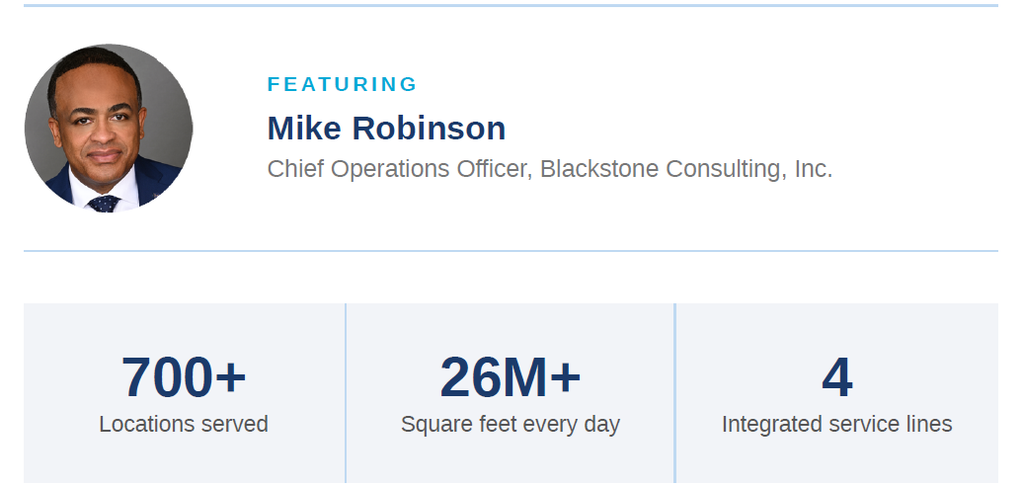
Mike Robinson oversees operations at Blackstone Consulting, Inc. (BCI), where teams deliver janitorial, security, food service, and facility maintenance across more than 700 locations and more than 26 million square feet every day. We sat down with Mike to talk about what clients should expect when they consolidate services, where the value comes from, and how executives can decide whether their portfolio is ready.
One point of contact, one line of accountability
Moving from several vendor contacts to a single one changes how the work gets done day to day. For Mike, the biggest shift is accountability.
“The accountability and the clear line of communication to accountability changes,” he says. “It’s always easier for the client to deal with one single point of contact. And then that point of contact would be the instrument to handle any concerns or rework, or ensuring that things are accomplished.”
“It’s always easier for the client to deal with one single point of contact.” — Mike Robinson, COO
Where integration works, and where clients hesitate
Consolidating services isn’t the right answer for every client, and Mike is candid about the concerns he hears most often.
“The key with some of these clients is not putting their eggs all in one basket,” he says. “But any company offering a multi-service solution should factor in contingencies and continuity plans that would build comfort between the service provider and the client.”
That means building multiple internal layers of accountability and continuity plans, Mike says, “so that clients never feel like all of their reliability rests on one person who could potentially fail.”
In practice, that means building redundancy into the model itself: redundant leadership so no account depends on a single manager, standardized processes that keep service consistent from site to site, cross-site resources that can be deployed when a location needs support, business continuity planning for disruptions, and defined escalation protocols so every issue has a clear path to resolution.
Some clients also weigh whether a single provider has the capacity to take it all on. “They want to make sure that they can handle the workload, financially, operationally, to make sure they have enough resources within their general team to respond,” Mike says. “Sometimes those contract dollar values could be so high that they feel that it may be best to spread it and give more opportunity to other vendors.”
Mike sees another side to that concern, especially for organizations with specific supplier goals. “The other piece to that would be a single source provider supporting small business utilization goals, minority spend goals throughout their team,” he says. “We could help the client with achieving those goals by taking on that responsibility and showcasing that we’re going to align with their goals and objectives.” As an NMSDC-certified minority-owned business, BCI can also support clients’ supplier-diversity objectives while managing additional diverse and small-business partners within an integrated delivery model.
Where the savings come from
When services are integrated under one provider, Mike says the first savings show up in management and oversight.
Instead of paying for separate management structures across three or four service contracts, an integrated model can consolidate oversight, reporting, and administrative functions. That can reduce duplicated overhead while giving the client one accountable management structure.
The second comes from the workforce itself. Where contract requirements, training, and labor classifications permit, an integrated provider can also create greater flexibility across the workforce. “From a continuity standpoint, it helps because you can tap into or cross-utilize the workforce in some cases, when you have a pool of employees that work for one company,” Mike says. “Janitorial and food service cross over really well, especially when it comes to the housekeeping side.”
Security teams cross-train well into adjacent roles too, he adds, strengthening coverage without adding headcount.
“Janitorial and food service cross over really well, especially when it comes to the housekeeping side.” — Mike Robinson, COO
One view of performance
Integration also creates an opportunity to standardize how performance is measured. Instead of separate reports, systems, and KPIs from multiple providers, clients can establish a common operating dashboard across service lines, making trends, service gaps, and corrective actions easier to identify and manage.
Is your portfolio ready to integrate?
For executives deciding whether to integrate services, Mike recommends starting with an honest look at the current program.
“If they could detail the pain points with the current situation, what could be operating better, and then what’s operating really well,” he says. “And then, are there financial objectives and budgets being met, service outcomes being met?”
In most cases, he says, the decision comes down to performance and budget. “Clients do this because either service outcomes aren’t achieving their goals and objectives, and most importantly, budgetary reasoning to consolidate services to save money, better performance,” Mike says. “Best value would be best-in-class services at the most cost-effective price.”
Five questions to ask before you consolidate
Building on Mike’s advice, we’ve put together five questions to help you get started:
- Count the calls. If three things went wrong in your building tomorrow, how many people would you have to contact?
- Count the reports. How many different formats do your providers use to tell you how they’re performing?
- Look for gaps. When did an issue last go unresolved because no contract clearly covered it?
- Protect what works. Which service is performing so well that you’d hesitate to change it?
- Check the overhead. Are you paying for separate account management, supervision, and training on every contract?
Not sure where your portfolio stands?
If you counted more than one call, more than one report format, or an issue nobody owned, it may be worth a closer look. BCI’s integrated services assessment maps your current vendors, pain points, and budget against what a unified model could deliver.
About BCI
Founded in 1991, Blackstone Consulting, Inc. (BCI) delivers janitorial, security, food service, and facility maintenance solutions for Fortune 100 companies, leading healthcare systems, the Department of Defense, and Homeland Security.